How long can I stop paying on a loan before I have to increase the repayment rate just to keep up with interest?

Photo credit: Pixabay
| \( B_0\) | Principal or loan balance at \(t=0\) |
|---|---|
| \( B_\text{stop}\) | Principal or loan balance when payments stop at \(t=t_\text{stop}\) |
| \( P \) | Repayment rate (dollars per time) |
| \( t_\text{stop} \) | Time at which loan payments stop |
| \( t_\text{deferred} \) | Time at which loan payments resume |
| \( t_\text{end} \) | Time when loan is paid off |
| \( r \) | Interest rate |
| \( \phi \) | Percentage of loan payment to interest |
| \( \phi_\text{stop} \) | \( \frac{rB_\text{stop}}{P}\) Percentage of loan payment to interest at \(t = t_\text{stop}\) |
Goals of this article
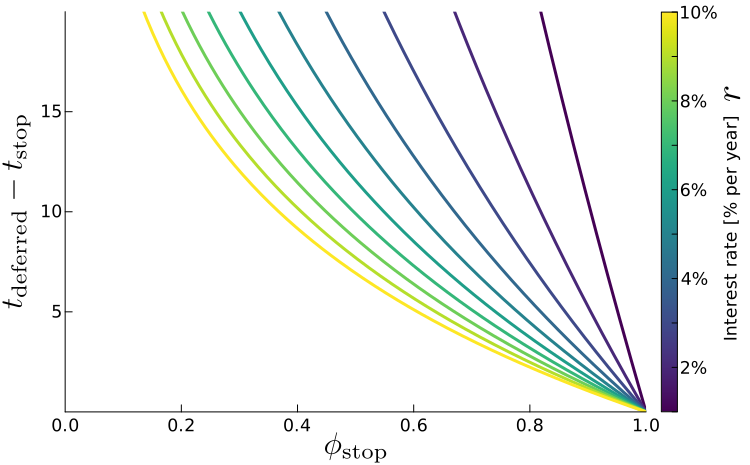
If a borrower stops paying on a loan for a short time when \( \phi(t)\) is small, the borrower can resume repaying the loan at the same rate and eventually pay off the loan. However, if they stop paying for a long time (or a short time if \(\phi(t)\) is large), there comes a point where the repayment has to increase if they are ever going to pay off the loan because the interest only repayment rate is now larger than the original repayment rate. This article will explore when this occurs.
Deferring payments until interest outpaces repayment
Let us divide the repayment into three periods, the initial period where things are going to plan, the period between \( t_\text{stop}\) and \(t_\text{deferred} \) where no payments are made, and \( t_\text{deferred}\) to \(t_\text{end}\) when payments resume and the loan is repaid.
$$ \frac{d B}{dt}= \begin{cases} rB - P & 0 \geq t < t_\text{stop}\\ rB & t_\text{stop} \geq t < t_\text{deferred} \\ rB-P & t_\text{deferred} \geq t < t_\text{end} \end{cases} $$The relevant question how much time can elapse between \( t_\text{stop}\) and \(t_\text{deferred} \) before \(rB(t) = P\). Here we define the balance at the time payments cease as \(B\left(t_\text{stop}\right) = B_\text{stop}\).
$$\begin{align} rB(t_\text{deferred}) =& P\\ rB_\text{stop} e^{r(t_\text{deferred} - t_\text{stop})} =& P\\ t_\text{deferred} - t_\text{stop} =& -\frac{1}{r} \log\left(\frac{rB_\text{stop}}{P} \right)\\ t_\text{deferred} - t_\text{stop} =& -\frac{1}{r} \log\left(\phi_\text{stop}\right) \end{align} $$This equation tells us how much time must pass without payments before the loan repayment rate must increase to keep up with interest.